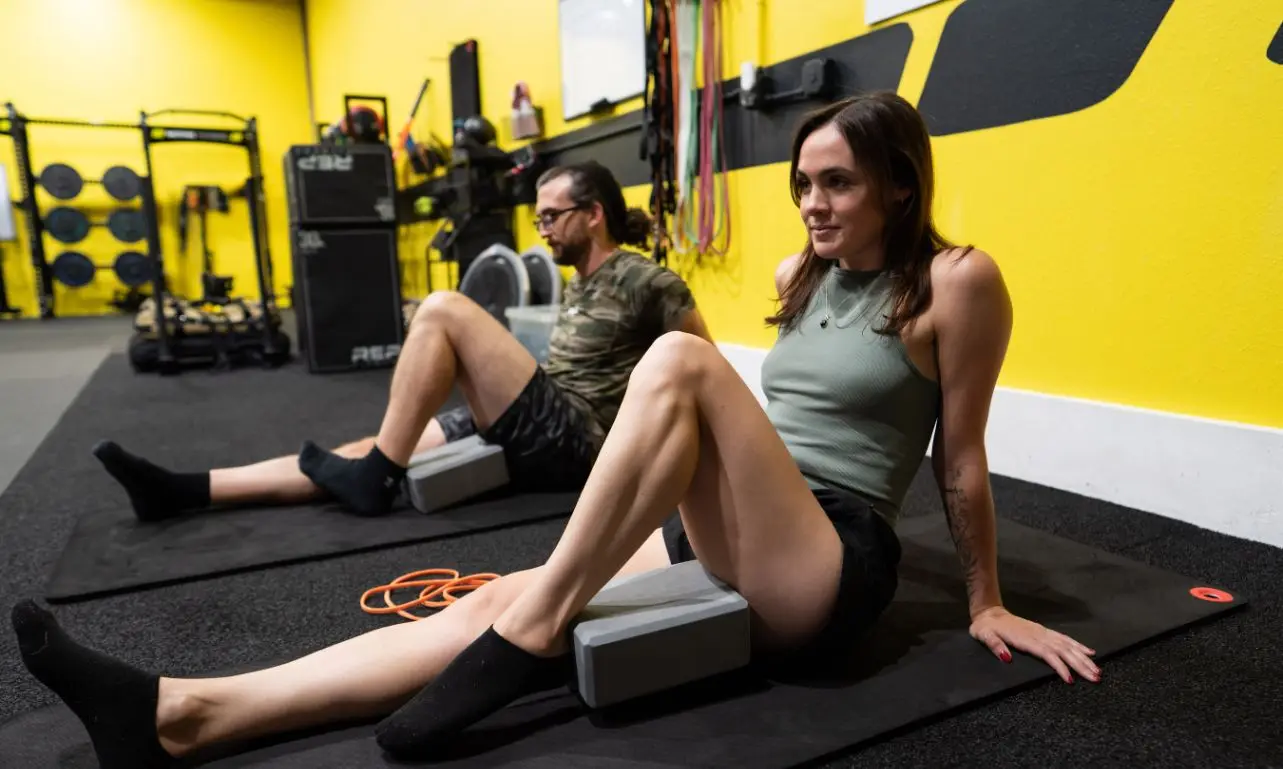
Most postpartum fitness content jumps straight to the abdomen, and for understandable reasons. The joints that shift the most during pregnancy rarely get mentioned at all, and they’re often still changed long after the six-week clearance appointment has come and gone.
Worth separating what’s well measured here from what’s widely assumed, because the two have drifted apart.
Joint laxity genuinely increases during pregnancy, and not only in the pelvis. A prospective study measuring seven peripheral joints across pregnancy found significant increases in laxity in five of them, and those increases were still present postpartum (1). That’s the piece that matters for training: the change is real, it’s measurable, and it doesn’t resolve the moment the baby arrives.
The explanation almost everyone reaches for is relaxin, the hormone associated with loosening the pelvic joints before delivery. It’s a tidy story and it’s repeated constantly. The research supporting it is considerably weaker than the confidence with which it gets stated. That same study found no correlation between serum relaxin levels and the joint laxity it measured, and concluded outright that the cause of the change was undetermined (1). A later systematic review looking at relaxin levels and pregnancy-related pelvic girdle pain rated the evidence for that association as low, with the higher-quality studies in the review finding no association at all (2).
I bring that up for a practical reason, not a pedantic one. When the mechanism gets treated as settled, the training advice that follows tends to get built around waiting for hormone levels to normalize, as though the tissue is on a hormonal timer and the job is patience. The measured reality is that laxity increases, persists past delivery, and has no demonstrated hormonal off-switch. Which means the useful response is the same one that applies to any joint carrying more range than it can control: build the strength and control to match the range, on a timeline set by the tissue rather than the calendar. We cover that broader idea, how long changed tissue actually takes to become trainable tissue, in how long it takes to improve mobility.
The hip is usually carrying more than people realize
The pelvis widens and the hip joints shift position to accommodate pregnancy, and postpartum, many people find their hips move and feel differently than before, sometimes with more available range in directions that feel unfamiliar or unstable. Training that jumps straight into squats and lunges without first checking what the hip can actually control in that new range risks reinforcing a compensation pattern before the joint has had a chance to build real strength at its new limits. More range on its own is not automatically good news. A hip carrying range it can’t yet control is a common finding in postpartum assessment, and it’s frequently still there in people describing hips that feel unstable or unreliable months and sometimes years after delivery. Working out if that’s what’s going on for any particular person is not something to guess at from a blog post, which is exactly what assessment is for.
The ribcage rarely gets mentioned at all
As the uterus expands, the ribcage physically shifts position, flaring outward at the base to make room. That shift changes how the diaphragm sits and how efficiently it can do its job, and it changes the mechanics of the entire trunk, since ribcage position affects thoracic rotation, breathing mechanics, and how load transmits through the spine. Postpartum, the ribcage doesn’t automatically snap back to its prior position and function. Retraining ribcage position and breathing mechanics is a real, trainable piece of postpartum recovery that almost never makes it into generic programming built around getting a certain look back, even though it affects far more than appearance. Our broader piece on why postpartum exercise matters more than people expect gets into this same territory from a different angle, focused on why the standard advice tends to undersell what’s actually changed.
What falls inside a trainer’s scope, and what doesn’t
Hip mobility, ribcage position, thoracic rotation, and general postural retraining are legitimate territory for assessment-based personal training. Pelvic floor dysfunction is not. If someone is dealing with symptoms like leaking, pressure, or pain that suggests the pelvic floor itself needs direct clinical attention, that’s a referral to a pelvic floor physical therapist, not something a trainer should attempt to diagnose or treat through general exercise selection. The two pieces work together well. A pelvic floor PT addressing the specific clinical picture, and a trainer addressing the hip, ribcage, and spinal mechanics around it, is a more complete approach than either alone, and it’s the model we use when a client needs both.
What actually helps
An assessment that includes hip and thoracic range gives a real picture of what changed and what’s been compensating for months, rather than assuming everyone’s postpartum body needs the identical program. From there, joint-specific training rebuilds the strength and control that the new range needs, at a pace that respects where someone actually is rather than where a generic six-week program assumes they should be. Our full postpartum training program walks through what that looks like in practice, session by session, once the initial picture is clear.
On timing, the honest answer is that it depends on the individual and the type of delivery, and it starts with clearance from a medical provider rather than with a template. Once that clearance exists, an assessment is a more useful next step than assuming a standard six-week program fits, since the joints involved may need a starting point that program never anticipated.
References
- Schauberger CW, Rooney BL, Goldsmith L, Shenton D, Silva PD, Schaper A. Peripheral joint laxity increases in pregnancy but does not correlate with serum relaxin levels. American Journal of Obstetrics and Gynecology, 1996
- Aldabe D, Ribeiro DC, Milosavljevic S, Dawn Bussey M. Pregnancy-related pelvic girdle pain and its relationship with relaxin levels during pregnancy: a systematic review. European Spine Journal, 2012
Written by

Brian Murray, FRA, FRSC
Founder of Motive Training
Motive Training is a coaching studio in South Austin built around assessment, joint health, and strength you can use. Train with us in the studio, come to a KINSTRETCH class, or work through the progressions in KINSTRETCH Online.