A desk job gives you sitting with options. You can stand up when you want to, or shift in a chair that adjusts. A travel day takes most of those options away. You go from the gate to a seat built for someone else’s body, often with your knees against the seat in front of you, and from there to a car. If you travel for work every week or two, that pattern stacks on top of the desk hours you already have.
A lot of people who fly often describe landing stiff and needing a day or two to feel normal again. Some of that is lost sleep and the general wear of travel. A good chunk of it is what a few hours in one position does to the joints, and that part you can do something about.
What a travel day does that a desk day doesn’t
The biggest difference is how little you can change position. In an economy seat the hips stay flexed somewhere around ninety degrees for hours, and you can barely shift your weight, let alone extend or rotate them. The upper back rounds into the seat shape, and if you sleep or read, the neck hangs forward or tips to one side against the window.
Joints that sit at one angle for a long time tend to stiffen at that angle. Tissue around the hip and spine gets used to the short range, and the nervous system gets cautious about the range you haven’t visited in a while. This is the same process we see with long desk days, which we covered in what sitting does to your body. Travel compresses it, because five hours with no option to move asks more of the joints than eight hours where you can at least get up for coffee.
The stiffness after a flight usually shows up in two places. The front of the hip resists standing fully upright, which you feel as a slow first few steps down the jet bridge. The upper back and neck feel locked, and turning your head to check a blind spot in the rental car takes more effort than it should. If you already deal with stiffness in these areas at home, the reasons you feel tight all the time apply here too, just compressed into a single day.
A note on circulation
Long flights also raise the risk of blood clots in the legs. A systematic review of the research found that long-distance travel increases the risk of venous thrombosis roughly two to fourfold, with an absolute risk of about one symptomatic event per 4,600 flights longer than four hours (1). For most healthy travelers that’s a small number. It goes up with certain medical conditions, recent surgery, pregnancy, and some medications, and if any of that applies to you, talk with your doctor before a long trip. Moving your legs during the flight is general advice that’s good for your joints too, so the routine below does double duty.
In the seat
You can’t do much in an airplane seat. The goal is to keep visiting the ranges the seat takes away, in small amounts, every half hour or so.
Ankle circles and calf pumps are the easiest place to start. Lift one heel at a time, then the toes, then draw slow circles with each foot. It looks like fidgeting and nobody notices.
For the hips, sit up toward the front of the seat and slowly rotate each knee in and out while keeping your foot on the floor. You’re asking the hip for internal and external rotation it doesn’t get otherwise. Then try a seated hip CAR in miniature. Lift one knee a couple of inches and trace the biggest circle you can with it without your pelvis rocking.
For the upper back, cross your arms over your chest and rotate slowly to each side, then tip your chest toward the ceiling a little and back down. Keep the movements slow and controlled; a fast twist in a cramped seat mostly annoys your neighbor.
For the neck, make slow, small circles with your nose, staying within a range that feels easy. If you’ve been asleep against the window, this matters more than anything else on the list.
In the aisle and at the gate
Any time you’re standing is a chance to get the hips into extension, which the seat never allows. At the gate or in the galley, take a long split stance, squeeze the glute of your back leg, and let your hips drift forward until you feel the front of the back hip open. Stay tall through your chest. Thirty seconds a side is plenty.
A standing hip CAR works well too. Hold a seatback or a wall, lift one knee, and move it through the largest circle you can control: up, out to the side, back behind you, and down. Go slow enough that the pelvis stays quiet. If you want the full explanation of why these controlled rotations are worth doing every day, our piece on the morning CARs routine covers it.
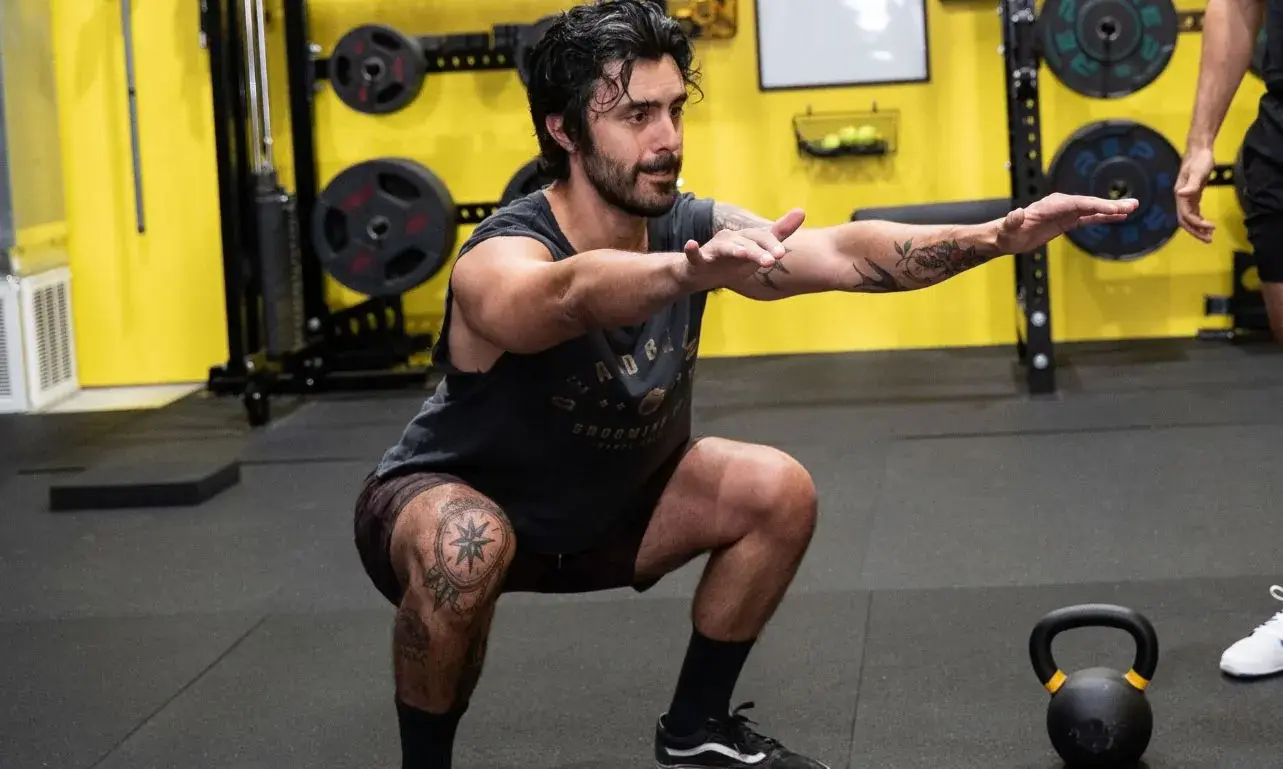
The deep squat is the other one worth doing when you have the space. Sit all the way down with your heels on the floor if you can (hold a railing if you need to) and spend a minute there, shifting side to side. It’s the position a travel day keeps you furthest from, and it gives the hips and ankles their full range back in one move.
A hotel-room routine with no equipment
Ten to fifteen minutes in the room after you land, or first thing the next morning, does more than an hour of trying to stretch your way out of it later. A simple sequence:
Start with CARs for the neck, shoulders, spine, and hips. Slow circles at each joint, a few in each direction, using as much range as you can control.
Move to the floor for hip work. A half-kneeling position with the back hip extended undoes the seat. The 90/90 position, with both knees bent and the legs at right angles on the floor, works hip rotation in both directions. Spend a couple of minutes in each, then contract into the floor with the leg you’re stretching for ten or fifteen seconds before relaxing deeper.
Finish with the upper back. On hands and knees, put one hand behind your head and rotate your elbow up toward the ceiling, following it with your eyes. Then lie on your back and let your arms rest overhead for a minute. If thoracic extension is something you struggle with in general, our breakdown of t-spine extension and posture goes deeper on it.
None of this needs a mat or equipment. A towel on the hotel carpet works.
Keeping the practice going when you’re away
The hardest part of frequent travel is that your routine at home falls apart every time you leave. Classes get missed, the training schedule slides, and after a few weeks of that it can feel like starting over.
KINSTRETCH Online fits this situation well. Classes run from ten to fifty minutes and need almost no equipment, so they work in a hotel room. If you’re local to Austin, coming to the studio is still the best version of this work, because a coach can see what your joints are doing. But a short session in a hotel room keeps the joints from settling back into the shape of the seat, and if you’re on the road a lot, that counts for more than a perfect session once a month.
A lot of the people who fly most also sit at a desk the rest of the week, which is why mobility training for tech workers overlaps so much with this piece. The travel days are the extreme version of the desk days, and the training that keeps a desk worker moving well is the same training that makes the flights easier to recover from.
References
Written by

Brian Murray, FRA, FRSC
Founder of Motive Training
Motive Training is a coaching studio in South Austin built around assessment, joint health, and strength you can use. Train with us in the studio, come to a KINSTRETCH class, or work through the progressions in KINSTRETCH Online.