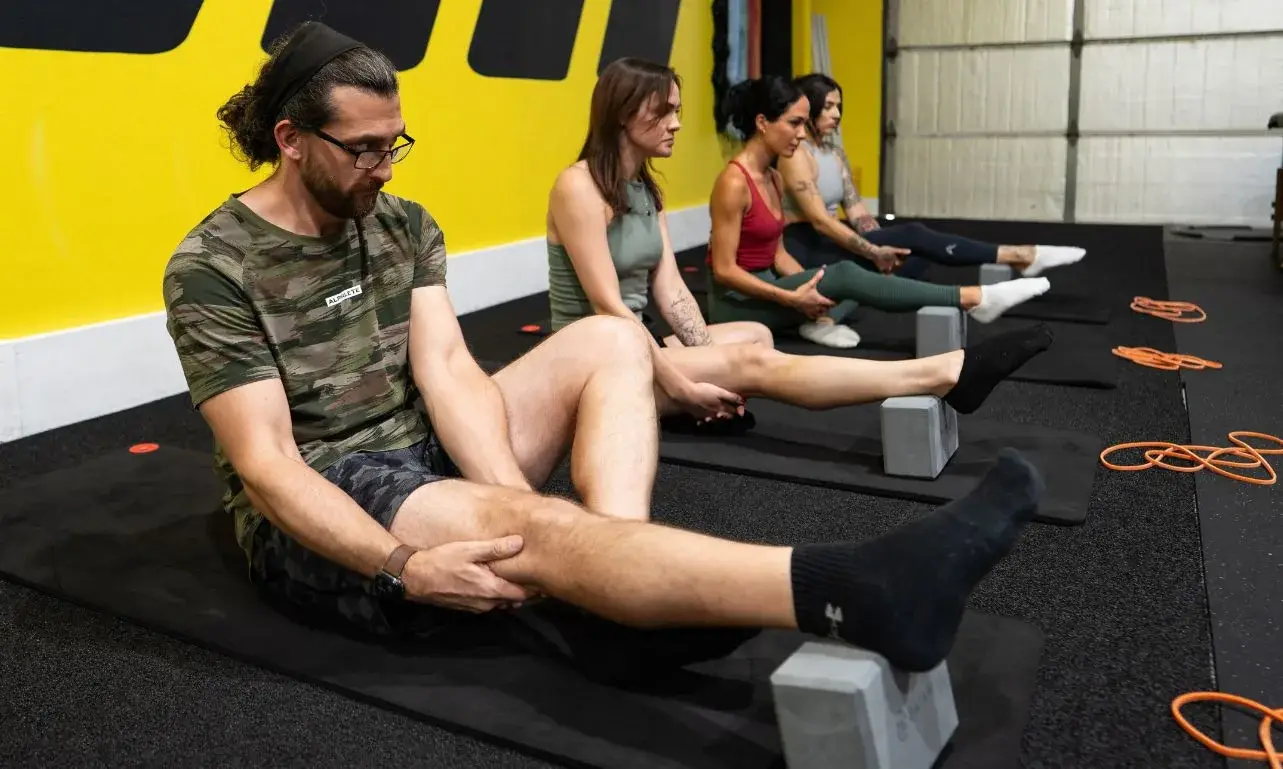
In September we changed how our stretching classes work. KINSTRETCH at Motive is now pay what you can, and 20 percent of what comes in goes to Farmshare Austin. Their CSA bags were already coming through our door, since the studio is one of their pickup locations, so the partnership started a little before the pricing did.
I want to explain the reasoning, because a pricing change says something about what we think the class is for.
Mobility should be something people can get to
The short version is that I want mobility to be accessible. The work we do in these classes is some of the most useful training a person can do for the long haul, and the people who’d get the most out of it are often the ones least likely to pay a monthly membership to find out. Someone who sits nine hours a day and can’t remember the last time their hips felt good doesn’t need another commitment to evaluate. They need a low-stakes way to show up and see what the class does for them.
A membership asks for that commitment up front. You decide you’re the kind of person who does this before you’ve done it. That works for people who already train and already know they want more joint work. It filters out a lot of people who’d benefit and aren’t sure yet, and some of them are exactly who the class was built for.
The other half of this is simpler. We love teaching these classes. A room full of people working through the same position, each at a different spot in their range, is one of our favorite parts of the week. More people in the room makes it better.
What pay what you can means in practice
You pay what fits your budget for the class you take. Drop-ins and punch cards are both donation-based, so you can come once and decide later, or buy a card if you know you’ll be back. You don’t need a membership or a contract.
Nothing about the coaching changes. Class sizes stay small and the same coaches teach, with the same corrections and progressions you’d get if the class cost more.
Why Farmshare Austin
Farmshare Austin is a local nonprofit, founded in 2012, that runs a 13-acre certified organic farm in eastern Travis County. Their Farmer Starter program trains new farmers through months of hands-on fieldwork and classroom instruction, with scholarships for students who couldn’t otherwise afford it. They also run food access programs that get fresh produce to Central Texas communities without reliable access to it.
Farmshare is doing incredible work, and we want to support it. We also have a direct connection to them. As a CSA pickup spot, their produce moves through our studio, and our members are the ones carrying it home. There’s a quiet overlap in what we’re both trying to do. They’re investing in the long-term health of the food system around Austin, and we’re trying to keep people moving well for decades, and neither of those pays off in a week.
Twenty percent of what comes in from classes goes to them. It’s a small studio, so it’s a modest number, but it’s a recurring one.
What the classes are
All of our stretching classes are KINSTRETCH, a system built on Functional Range Conditioning. If you want the full explanation of the method, how KINSTRETCH works covers it in depth. The short version is that the class trains your joints to move through more range and builds strength and control in the range you have. Most of the hour is active work. You’re contracting into positions, holding them, and moving through them under control.
We run three classes a week, each with its own focus. Lower Body and Spine covers everything from the feet up through the spine. Upper Body and Spine works the shoulders and arms along with the spine. Restore is a slower recovery class for days when your body wants less intensity and more attention. If you’re not sure where to start, pick the class that lines up with what feels stiffest, or the one that fits your week. The current class schedule has days and times.
This is a different kind of class from what a lot of people picture when they hear “stretching.” There’s a reason passive stretching on its own tends to plateau, and the active, loaded approach in KINSTRETCH is our answer to it.
If you’ve never been
The most common worry we hear is some version of “I’m not flexible enough for this.” You don’t need to be. A restricted joint usually has more room to gain than one that already moves well, and everyone starts from their own range. Our guide for first-timers goes through it in more detail.
A typical class opens with CARs, which are slow, controlled rotations of each joint. They warm you up and tell the coach (and you) how your body is moving that day. From there the class works through a series of positions, with stretching under load and end-range strength work, and finishes with dynamic rotational work. The coach will adjust positions for you as you go, which is most of the value of being in the room.
Wear something you can move in, and come a few minutes early the first time so we can ask about any injuries and get you set up.
The stretching classes page has everything you need to book. Pay what you can, and if you grab a CSA bag on the way out, you’ve supported the same farm twice in one visit.
Written by

Brian Murray, FRA, FRSC
Founder of Motive Training
Motive Training is a coaching studio in South Austin built around assessment, joint health, and strength you can use. Train with us in the studio, come to a KINSTRETCH class, or work through the progressions in KINSTRETCH Online.