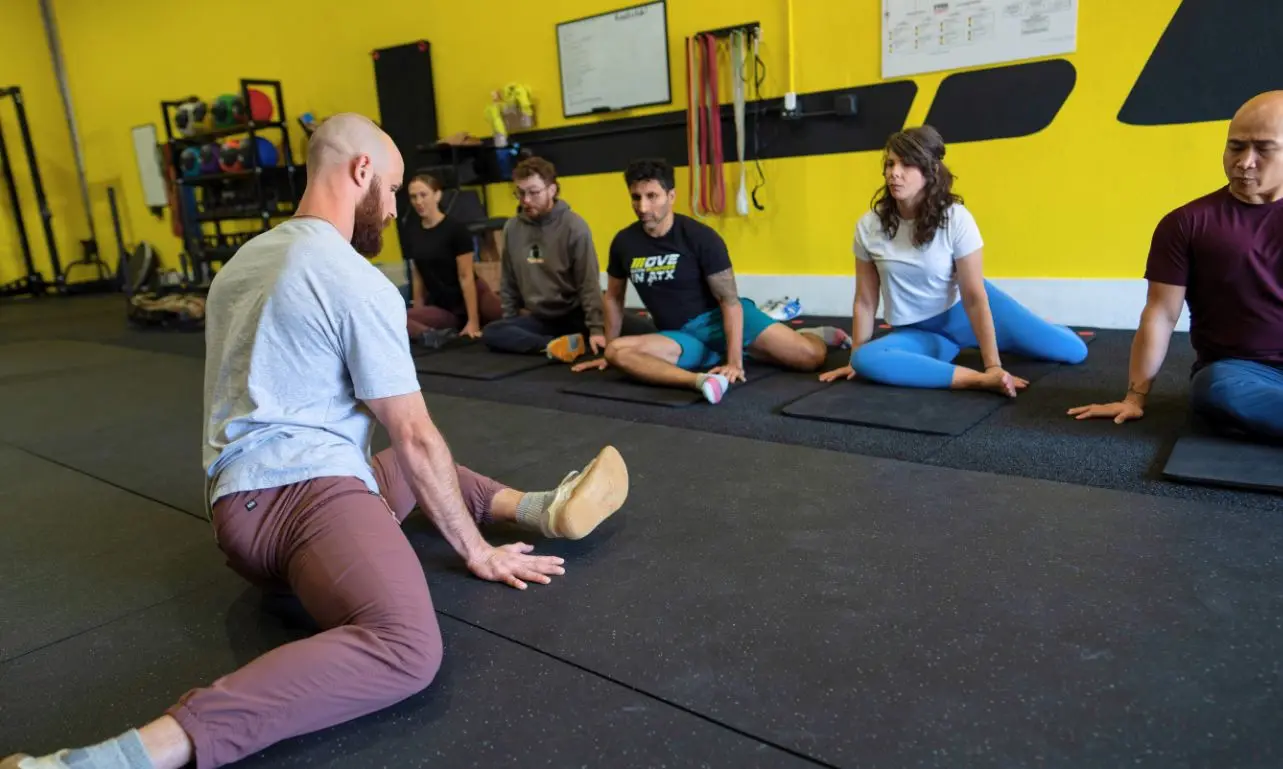
Plenty of people walk into Motive without a single complaint about pain. Nothing hurts, they train regularly, and by most measures they’d say they’re in solid shape. What brought them in is harder to name: a squat that won’t get any deeper no matter how much warming up happens beforehand, a shoulder that catches at the same spot overhead every time, one side of the body that has just always moved differently than the other.
Why no pain gets read as no problem
A restriction with no pain attached doesn’t demand attention the way pain does, so it’s easy to file it under quirk, or under mobility work to get around to eventually, or under how that joint has just always been. One that’s been sitting there long enough usually isn’t going anywhere on its own. Months of foam rolling and stretching before every session with nothing moving is real information, worth examining directly, and how to know if mobility training is what your body needs is a reasonable place to start before assuming more of the same eventually works.
What restriction without pain usually points to
Restriction without pain generally comes down to one of two things, sometimes both together. Either the joint doesn’t have the passive range available at that specific position, or the range is there and the nervous system won’t let the person use it without support. These look identical from the outside and need completely different work. Loading a joint that lacks passive range harder just teaches the body a new way to compensate around the block. Building active control into a joint that already has enough passive range, but no strength there, is the fix in that second case, and it calls for a different set of exercises entirely.
Generic mobility advice tends to blur this distinction. A position like 90/90 gets recommended constantly as a fix for hip mobility, and it might help. It might also miss the mark completely, because addressing what’s restricted depends on where a specific person’s limitation sits, information a feed post has no way of knowing.
Competence is the real driver here
For someone in this position, being stuck bothers them out of proportion to any symptom, and that’s worth naming plainly. Nothing hurts, nothing is getting worse in any obvious way, and the frustration is still real. That’s usually because someone training seriously already has a working relationship with their own body: they notice asymmetry and inefficiency the way a mechanic notices a new rattle in an engine that still runs fine. The goal here is closing the gap between what the body can technically do and what it’s allowed to access under real training conditions.
There’s a version of this that shows up constantly in people who already train hard: a hip that opens fine passively on the table but won’t cooperate the moment real load enters the picture. The range was never the missing piece. The missing piece was the nervous system’s willingness to hand over control of that range under tension, which is a training problem, not a flexibility problem, and it responds to a completely different kind of work than another round of static stretching before the warmup.
Where an assessment fits when nothing hurts
A joint-by-joint look at where passive range and active control diverge is a more useful starting point here than chasing a symptom that doesn’t exist, which is exactly what a functional range assessment is built to find. It functions as a measurement exercise, looking for where the gap between passive range and active control sits, a different question than the one most pain-focused evaluations are built to answer. Understanding the difference between a movement screen and a joint-level assessment helps before picking a starting point.
Once that gap is mapped, training follows a joint-by-joint logic, closing specific ranges one at a time instead of stretching broadly and hoping something sticks.
FAQ
Do I need an assessment if nothing hurts?
An assessment is just as useful without pain in the picture. A specific position or movement that consistently feels stuck, off, or asymmetrical is exactly the kind of thing an assessment is built to locate precisely, instead of guessing at it through more general stretching.
How is this different from just stretching more?
Stretching addresses passive range: how far a joint can be moved when something else is doing the moving. It does very little for active control: the nervous system’s willingness to let someone access that range under their own strength. A joint-by-joint approach trains both pieces on purpose instead of assuming more stretching eventually solves a control problem.
Written by

Brian Murray, FRA, FRSC
Founder of Motive Training
Motive Training is a coaching studio in South Austin built around assessment, joint health, and strength you can use. Train with us in the studio, come to a KINSTRETCH class, or work through the progressions in KINSTRETCH Online.