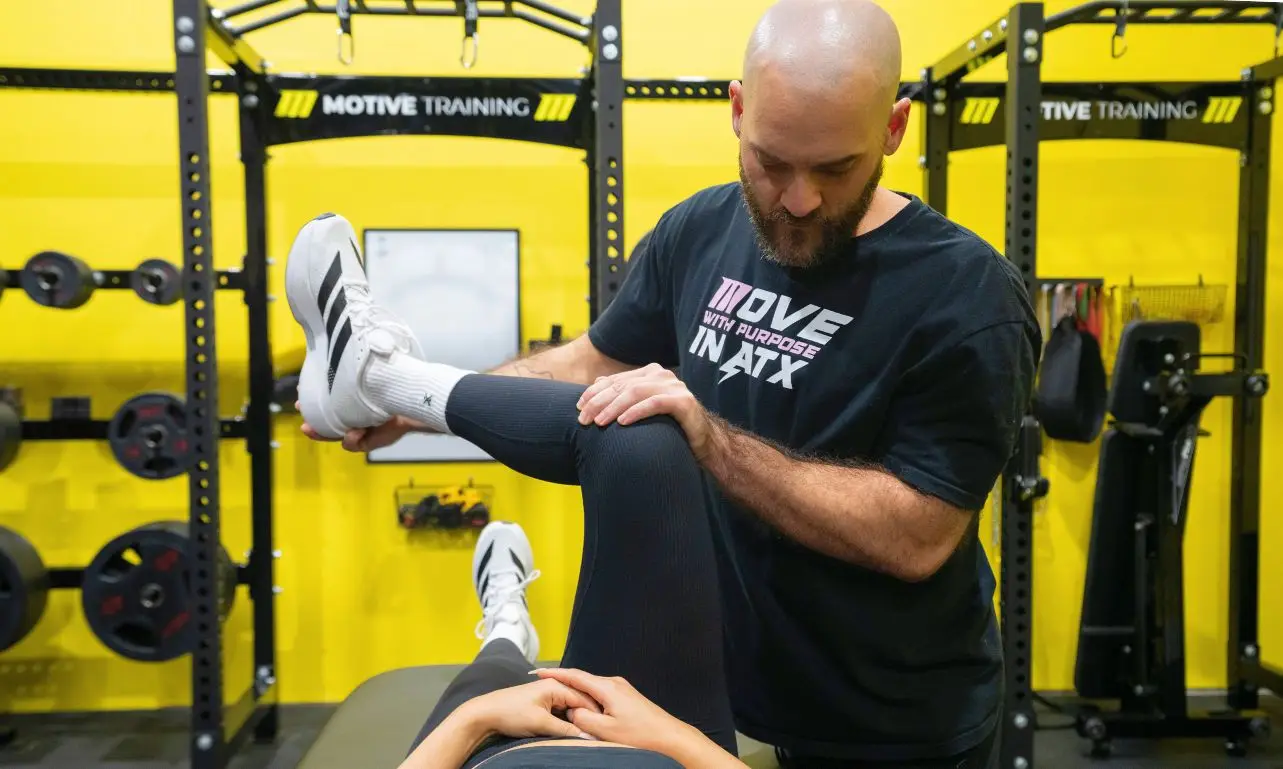
I’m training someone right now who has had both hips replaced. Their external rotation has held up reasonably well. Internal rotation is a different story: it’s completely stuck, and getting it back has been a struggle. It is coming back, though, and that’s the part I’d want anyone in the same position to hear. A stuck hip after a replacement is a starting point, and with the right clearance it’s trainable.
This post is for people who’ve already been cleared by their surgeon and discharged from physical therapy. If you’re still in the early weeks of recovery, the plan belongs to your surgeon and your physical therapist, and nothing here should replace it.
What discharge usually means
Physical therapy after a joint replacement is built to get you safe and functional: walking, stairs, getting in and out of a car, living within whatever precautions your surgeon set. It’s very good at that. It usually ends when those goals are met or when the covered visits run out, and neither of those means the operated side is as strong as the other one, or that the hip has its full range back.
The PT did the job the system set up for it, which is getting you back to daily life. Building the reserve for everything past daily life is a longer job than a course of visits covers. I wrote more about that gap in training after physical therapy.
Clear these things first
Before anyone loads a new hip, a few questions need answers, ideally from your surgeon in writing.
Which approach was used, and do any movement precautions still apply? Hip replacements are done through different approaches, and the positions to avoid (and for how long) differ between them and between surgeons. Some people are told to limit deep hip bending, crossing the leg, or turning it inward for a period; others are told to avoid the leg reaching far behind them with the foot turned out; some get few restrictions at all. A trainer should never guess at this, and it decides when and how rotation gets trained.
Are there any limits on load, impact, or particular activities? Some surgeons are relaxed about lifting and want people to avoid running; others have their own preferences. Ask.
Is there anything else in the picture? The other hip, the knees, the low back, bone density. A hip replacement often isn’t the only thing going on, and the program has to account for all of it.
Why rotation is often what’s left
The hip capsule is opened during the surgery, and depending on the approach, turning the leg inward may be one of the positions you’re told to avoid for weeks afterward. A motion the hip is kept out of for that long, around tissue that’s been cut and has healed, can be hard to get back. Daily life rarely asks for much of it either, so it’s easy to miss until someone measures it.
Rotation matters because the hip uses it constantly. Turning to step into a car, pivoting on one foot, the back hip in a stride; all of it asks the femur to turn in the socket. When one direction is stuck, something else (the low back, the knee, the other hip) makes up the difference.
Once your surgeon has cleared rotation in a given direction, we train it the way we’d train any hip that’s lost internal rotation: measure it, open it gradually, then build strength in the range as it comes back. The pace is slower after a replacement, and the limits you were given come first. Controlled hip circles are part of this, and a full circle passes through deep bending with the leg turned in and across the body, which is exactly the position some approaches restrict, so the circle gets shrunk or reshaped to stay inside your limits until your surgeon says otherwise.
What else training adds
Strength on the operated side. Even when walking looks normal, the muscles around the new hip (the glutes, especially the ones on the side of the hip that hold the pelvis level, and the quadriceps) often lag behind the other leg for a long time. Single-leg strength work is how we find and close that gap, started well inside what’s comfortable, progressed in small steps, and set to whatever your precautions allow. Two-legged lifts are useful too, though the stronger leg will happily do more than its share in them if nobody’s watching.
Balance and deceleration. A lot of what makes people nervous after a joint replacement is the thought of a stumble. Standing on one leg is part of balance, but the version that matters on a curb is being able to catch yourself, absorb the force, and stop. That’s trainable, the same way we approach it in strength training for seniors, with small, controlled shifts that get bigger as control improves.
Getting down to the floor and back up, if your surgeon is fine with it. It’s one of the most useful things to be able to do and one of the first things people quietly stop doing after hip surgery.
What to ask a trainer
Have you worked with people after joint replacements? How many, and how recently?
Will you ask about my surgical approach and precautions before we start? The answer should be yes, without you having to bring it up.
How do you decide how much to load the operated side, and how do you progress it? Listen for testing each leg on its own and retesting over time, with numbers you can compare.
Will you talk to my surgeon or physical therapist if a question comes up? A yes, with an example of having done it, is a good sign.
Be cautious about anyone who promises the hip will be “better than new,” who treats the new joint as fragile forever, or who runs the same session they’d give anyone else without asking about the surgery at all.
How we start at Motive
Everyone who trains with us starts with an assessment, and after a joint replacement that’s where we compare the two legs, measure rotation in both directions, check balance and the floor transfer, and go through what the surgeon has and hasn’t cleared. The Motive Movement and Mobility Assessment is where the plan comes from. Training is one-on-one at our South Austin studio, $105 to $125 an hour, and HSA and FSA eligible through Truemed with a Letter of Medical Necessity; we help with the paperwork after booking. Our South Austin personal training page has the rest.
Written by

Brian Murray, FRA, FRSC
Founder of Motive Training
Motive Training is a coaching studio in South Austin built around assessment, joint health, and strength you can use. Most clients start with the Movement & Mobility Assessment. From there, train with us in the studio, come to a stretching class, or work through the progressions in KINSTRETCH Online.